AI Project 4 — LLM from Scratch
UrduGPT
A character-level transformer built from scratch on 290 million Urdu characters — with attention
visualization, interpretability analysis, and a direct comparison against Gemma 4 12B.
The first interpretability study on a Urdu language model.
PyTorch
11M params
MPS (Apple Silicon)
290M chars
Karpathy nanoGPT
Urdu Wikipedia
Ollama
Matplotlib
By the numbers
How it was built
📚
Corpus
Urdu Wikipedia dump — 264K articles, 290M chars, 327 unique characters
🔤
Tokenizer
Character-level — every Urdu glyph maps to a unique integer ID
🧠
Model
6 layers × 6 heads × 384 dims — full transformer from scratch
⚡
Train
5,000 steps on Apple Silicon MPS — AdamW, gradient clipping
🔍
Interpret
Attention weight extraction across all 36 heads — 4 Urdu phrases
What the model learned
Finding 1 — Layer 0 specialization
All of Layer 0 spontaneously became "previous token" heads
Without any instruction, 5 of 6 heads in Layer 0 learned to attend strongly to the immediately
preceding character. This makes sense for Urdu — the language has highly predictable character
sequences due to its morphological structure. The model discovered that tracking "what came before
me" is the most useful signal for predicting the next character. One head (L0H5) specialized
differently — behaving as a positional anchor across all phrases tested.
Finding 2 — Hierarchical learning
Layer 0 learns character sequences. Layers 1–5 learn word patterns.
A dramatic behavioral shift occurs between Layer 0 and Layer 1. By Layer 1, LOCAL attention
(attending to a window of nearby tokens) dominates — the model is now building word-level context
rather than character-level sequences. This mirrors findings from interpretability research on
much larger models like GPT-2, reproduced here at 11M parameters on a low-resource language
nobody has studied this way before.
Finding 3 — Dataset bias
UrduGPT learned that "Pakistan" means cricket
Regardless of the seed word, UrduGPT frequently generates cricket-related content. Urdu Wikipedia
has a disproportionate amount of cricket articles, so the model over-indexed on this pattern.
This is a real problem in low-resource language modeling: when one topic dominates the available
corpus, the model's world model becomes distorted. A genuine finding about dataset composition
in Urdu NLP.
Interpretability charts
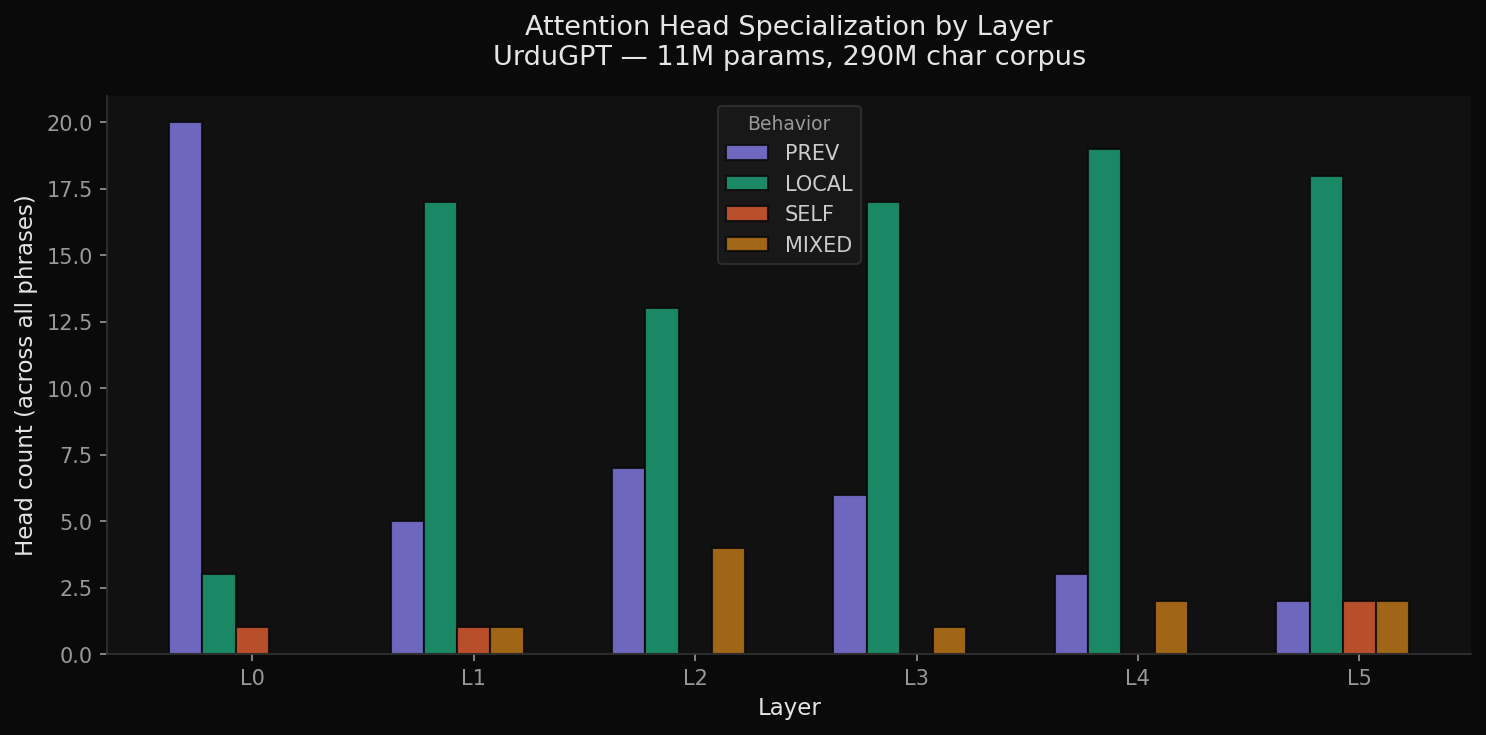
36 heads across 6 layers measured on 4 Urdu phrases. Layer 0: dominated by PREV heads (purple) —
the model learned to track the previous character. Layers 1–5: LOCAL attention (teal) takes over,
building word-level context. Same hierarchical shift seen in GPT-2 and larger models, reproduced
here at 11M parameters on Urdu.
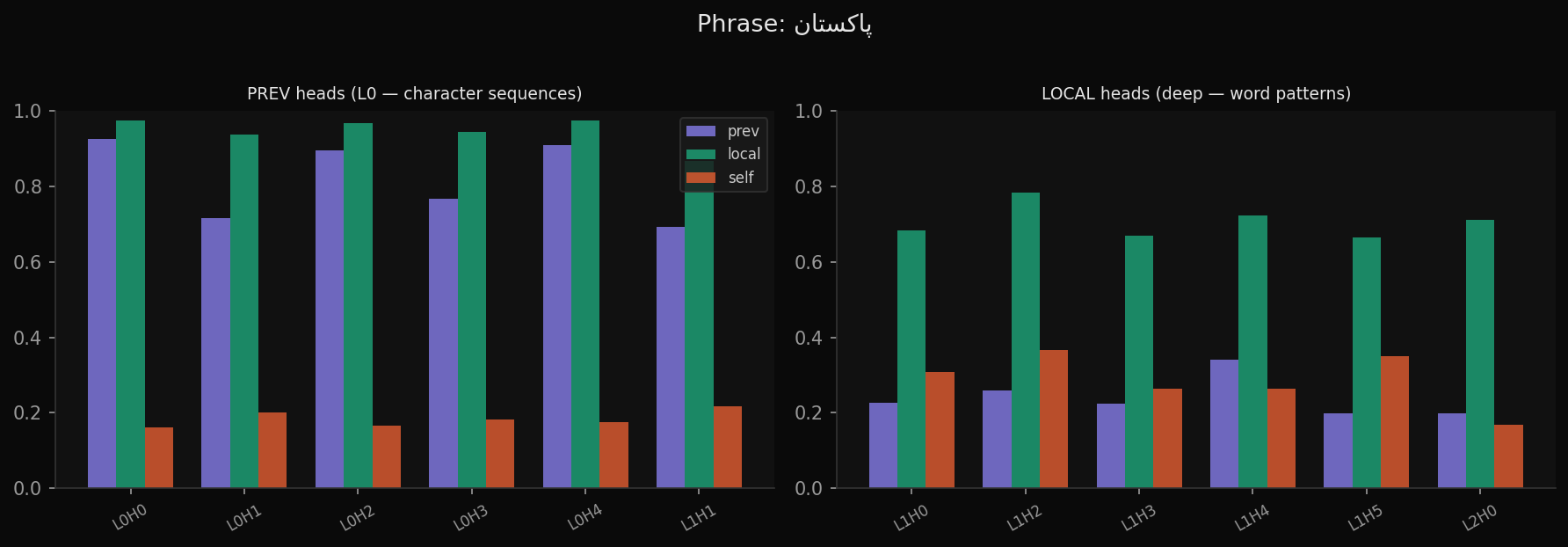
پاکستان — PREV heads in L0, LOCAL in deeper layers
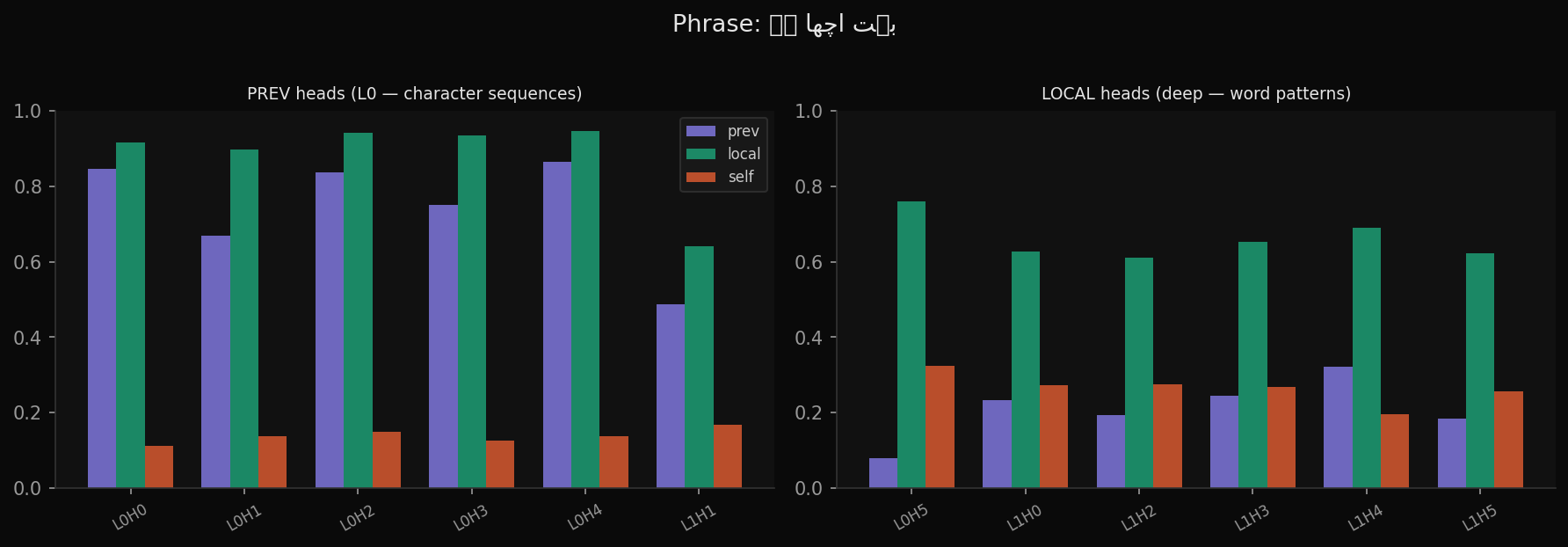
بہت اچھا ہے — same pattern, different phrase type
UrduGPT vs Gemma 4 12B — side by side
The same seeds run through both models. The gap illustrates exactly what scale, training data,
and RLHF buy you — and what 41 minutes on a MacBook cannot.
UrduGPT (11M params)
Gemma 4 12B (1,000× larger)
SEED: علم (knowledge)
علم ایوارڈ اسکول میں بین الاقوامی بین الاقوامی بین الاقوامی بین الاقوامی...
SEED: علم (knowledge)
علم نور ہے، جہالت اندھیرا۔
SEED: محبت (love)
محبت کرنے والے حوالے کے صحن کھالے میں پیدا ہوئے اور انھیں میں سے نایاب درگاہ ہو گیا۔
SEED: محبت (love)
محبت ایک شفقت ہے، ایک چاہت ہے۔ یہ دلوں کو جوڑتی ہے۔
SEED: آج کا موسم (today's weather)
آج کا موسم ہو گئے۔ کیفیت کے بعد انھوں نے اسٹیڈیم کے خلاف رنز بنائے...
SEED: آج کا موسم (today's weather)
آج کا موسم بہت ٹھنڈا اور خوشگوار ہے۔
UrduGPT learned form. Gemma 4 learned meaning. The difference is 1,000× parameters,
hundreds of billions of training tokens, and RLHF fine-tuning.
Architecture
MODEL
Decoder-only transformer following Karpathy's nanoGPT architecture. 6 layers, 6 attention heads per layer, 384 embedding dimensions, 256-token context window. 10,990,407 total parameters.
TOKENIZER
Character-level — 327 unique Urdu/Arabic script characters. Every possible Urdu text is representable. The model learns morphology from scratch rather than relying on subword segmentation.
TRAINING
AdamW optimizer, lr=3e-4, batch size 32, block size 256. Gradient clipping at 1.0. Dropout 0.1. 5,000 steps on Apple Silicon MPS GPU. Val loss 0.49 at convergence.
CORPUS
Urdu Wikipedia — 264,959 articles, 290M characters. Custom XML parser strips markup, keeps only Urdu Unicode range (U+0600–U+06FF). 90/10 train/val split.
INTERPRETABILITY
Attention weight extraction across all 36 heads (6 layers × 6 heads). Heads classified as PREV, LOCAL, SELF, or MIXED. Behavior visualized across 4 Urdu phrases spanning proper nouns, verb phrases, and predicates.
What comes next
P5
Urdu Fine-tuned Assistant — LoRA fine-tune Llama 3.2 on Urdu corpus. What UrduGPT cannot do (answer questions with meaning), a fine-tuned 3B parameter model can. Runs locally, private.
P6
Mechanistic Interpretability — deeper circuit analysis on the P5 model. What attention heads specialize in at 3B scale vs 11M? Apply TransformerLens to find specific Urdu morphology circuits.
P7
Multilingual extension — extend the Urdu model to Farsi and Arabic. All three share Arabic script. The OSS contribution: a multilingual Abrahamic language model covering ~500M speakers in an underserved script family.